




Best Practices for Aircraft Parts Supply Chain Management
Author: GA Telesis
Key takeaways
- A missing part grounds an aircraft, so the parts supply chain is the difference between a delay and a dispatch.
- Aviation supply chains are not generic. Traceability, airworthiness paperwork, AOG urgency, and long OEM lead times change every best practice.
- Build traceability in from the start. Provenance and documents like the FAA 8130-3 and EASA Form 1 are integral, not optional.
- Used serviceable material (USM) is a strategic lever. It cuts cost and lead time and supports sustainability, with proper quality and traceability controls.
- Classic inventory methodology still applies. Criticality ranking, reorder points, and demand forecasting decide which spares earn a place on the shelf.
- Consolidating distribution, repair management, and logistics with one integrated partner shortens the chain and reduces AOG risk.
In aviation, parts availability drives up time. When the right part is on the shelf, or one call away, an AOG or fault becomes a quick fix. When it isn’t, an aircraft sits, and the costs climb by the hour. That is why aviation supply chain management deserves the same spotlight and rigor as flight operations. In most airline operations today, these practices are well understood and applying them consistently separates a resilient aircraft parts supply chain from a fragile one. Below, we outline five aviation supply chain best practices for keeping aircraft parts available and maintenance costs in check.
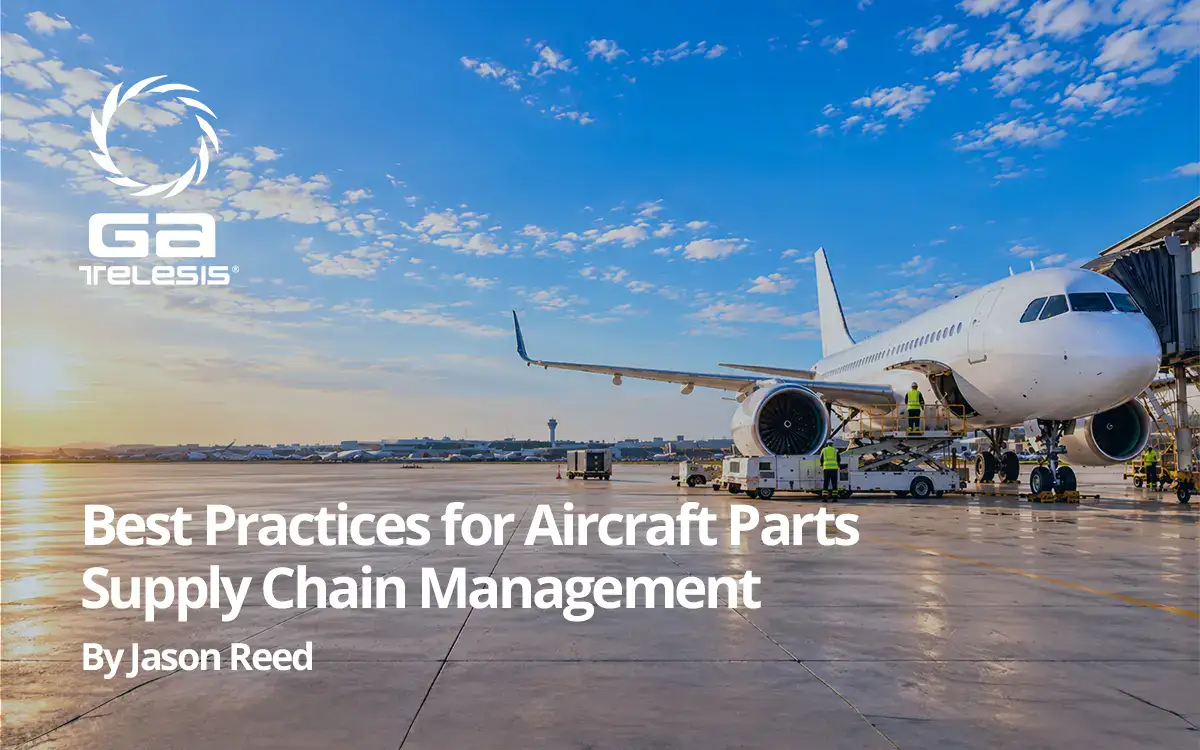
Aircraft on tarmac at sunset with GA Telesis logo, illustrating aircraft parts supply chain management.
Why aircraft supply chains are different
Generic supply-chain advice only takes you so far in aviation because the parts and their logistics carry their own rules. Every serviceable part must be traceable and move with airworthiness documentation, such as the FAA Form 8130-3 or the EASA Form 1. Provenance is not a nice-to-have; it’s a must. A part without the right paperwork cannot go on an aircraft, no matter how new it looks or how urgently it is needed. Making that paper trail digital and verifiable is the idea behind GA Telesis’ WILBUR platform, which uses blockchain technology for aircraft parts traceability.
Two more realities shape the process. Aircraft-on-ground events create sudden, non-negotiable demand where speed matters more than in most industries. Supplier lead times for some parts run long, while older fleets face obsolescence as production ends and the original supply chain downstream moves on. A rotable that was easy to buy a few years ago can sometimes become a months-long wait. Those occurrences turn routine maintenance into a scheduling and lost revenue problem. A good aircraft parts supply chain is designed around those facts, not despite them.
The cost of getting supply chain management wrong is asymmetric. Carrying an extra spare you never fit is expensive, but grounding a revenue aircraft because you need a single line-replaceable unit is far more expensive. Demand forecasting shapes how you weigh every stocking and sourcing decision that follows.
Best practice 1: build aircraft parts traceability from the start
Traceability underpins the aviation supply chain, so treat it as a requirement at every step, not a box to tick at receiving. Source only from approved quality suppliers and insist on complete airworthiness and provenance documentation. The documentation of those records should be stored in a proper ERP system, so they are readily available when an auditor or an engineer requests a review. The paper and electronic trail should let you trace a component through its repairs and prior operators back to the point it entered service. It should also include additional airworthiness releases, such as the FAA’s Form 8130-3, while its EASA equivalent, Form 1, does the same job in Europe. Both attach to the part and travel with it, so losing the tag or trace documentation can strand an otherwise serviceable unit or deem it scrap.
Regularly auditing your paperwork and ERP is a necessary, time-based requirement, not something you do only when something goes wrong. Getting this right protects both safety and value, because an undocumented part is effectively unusable no matter what you paid for it. A part with a clean, verifiable history holds its worth through storage, resale, exchange, and the next check. Without one, a part becomes a write-off waiting to happen.
Best practice 2: source used serviceable material strategically
Used serviceable material (USM), certified parts harvested from aircraft and engine teardowns, is one of aviation’s most effective cost levers. Using a certified USM part instead of buying new can lower costs and shorten lead times. It supports sustainability by keeping a serviceable part in service rather than manufacturing a replacement. For an out-of-production part or aircraft type, USM is often the only practical way to keep a fleet flying.
Here is what that means in practice. When an OEM quotes a long lead time on a new component, a certified serviceable unit from teardown stock can close the gap in a fraction of the time and at a lower price, provided the documentation is clean back to the last operator or back to birth. USM only works when the traceability and certification are solid, so make your approved supplier list a source that stands behind the paperwork and can show the part’s release history on request.
GA Telesis’ Flight Solutions Group supplies certified USM and new material from its own teardown and distribution operations. Within the business, the same management platform runs disassembly, procurement, distribution, and repair management. Overall, the team is highly trained in provenance retention and documentation. No matter what the operation within the group, the supply chain process stays intact from the moment an asset is torn down, or a part is purchased to the moment a part reaches your line. Internal quality management teams and external audits, including ASA-100 accreditation and an AS9120 quality system, hold our quality to a high standard so the end operator can rely on our parts for their supply chain needs.
Best practice 3: plan spare parts inventory for AOG and demand variability
Everything is neither practical nor financially wise, so plan for actual demand. Identify the parts whose absence grounds an aircraft or blocks a major maintenance event and prioritize them in your stocking and sourcing plans. A cheap consumable that is easy to reorder does not deserve the same attention as a costly rotable with a long lead time and no substitute. Data and automation, rather than manual tracking alone, are the key to managing that balance.
From there, established aircraft spare parts inventory management methodology applies. A common starting point, consistent with standard supply chain and inventory practice, is to rank parts by criticality and usage with an ABC-style analysis, supported by reliability data such as mean time between unscheduled removals (MTBUR). Then set reorder points and min/max levels based on actual lead times and observed usage. Forecast demand from maintenance schedules, check intervals, and known fleet changes. These are guidelines to apply with judgment, not laws, but they give a repeatable way to decide how deep to stock each line item.
Another common tactic, a rotable pool, spreads the cost of expensive, rarely used rotables across operators of the same type. Additionally, consignment keeps supplier-owned aircraft spare parts on your shelf rather than at their distribution center, paid for only when you use them. This is a vital way to protect availability without tying up your capital. For high-value assets like landing gear and APUs, a ready-to-go lease and exchange pool can cover a scheduled change without the wait or the cost of holding a spare outright. The aim here is not maximum stock, but just enough. Creating that balance per type of part is vital in managing overall costs while reducing cost per available seat mile (CASM).
Best practice 4: vet your suppliers before you need them
Having an aircraft down in the middle of an AOG is the worst time to discover a supplier cannot deliver. An approved supplier list that is audited, contracted for material, and regularly scored is the key success factor in supply chain management. Well-run airlines manage the supplier, not the parts. Vet the supplier network before the pressure is on, so when a part grounds an aircraft, you already know who will provide the right support in the least amount of time.
Vetting a supplier comes down to a few key criteria. Do they hold the accreditations that matter, such as FAA, EASA, ASA-100, or an AS9120 quality system for distributors? Can they produce full traceability and airworthiness documentation on demand, not eventually? Do they have efficient ERP systems? What is their quality record like? What is their real-time record on fill rate and on-time delivery, and can they support an aircraft-on-ground request around the clock and around the globe, not just during business hours? The depth of each supplier’s product lines also matters. A supplier who can provide new components, rotables, and USM from a single inventory saves you from piecing together three vendors under time pressure.
Build the relationships while things are calm. A supplier who already knows your fleet, paperwork standards, and approval process moves faster when it counts because the groundwork is done before the clock starts.
Best practice 5: consolidate with an integrated partner
Every handoff in a supply chain is a place where delays and errors can creep in. Each transfer between a parts supplier, a repair shop, and a logistics provider adds a queue, a document exchange, and a chance for something to fall through the cracks. One of the most effective ways to de-risk is to shorten the chain by consolidating with a partner that can do more under one roof.
When distribution, serviceable material, repair management, and logistics come from one integrated platform, there are fewer entities to coordinate and fewer seams for an AOG to fall through. GA Telesis’ Flight Solutions Group is built to handle supply chain, logistics, repair, procurement, consignment, and on-shelf inventory management, with distribution solutions that move parts worldwide. Paired with our MRO and repair management teams, GA Telesis allows an operator to run a shorter, more predictable supply chain. This is where an integrated platform earns its keep. The value lies less in the length of the service list than in getting a repair or a replacement part from the same partner, wherever the airline operates.
Aircraft parts supply chain FAQs
What is aviation supply chain management?
It is the sourcing, stocking, traceability, inventory product line, and logistics of certified aircraft parts, managed to keep aircraft available while controlling cost and meeting airworthiness requirements.
What is used serviceable material (USM)?
USM is certified parts recovered from aircraft or engine teardown and returned to service via approved CMM maintenance practices. It can lower cost and lead time versus new material, provided the traceability and certification are sound.
How do airlines reduce AOG risk?
By stocking the truly grounding parts, forecasting demand, sharing risk through pooling or consignment, vetting suppliers in advance, and working with a responsive distribution partner who can move fast.
What is FAA Form 8130-3, and what documentation do aircraft parts require?
FAA Form 8130-3 is the FAA’s authorized release certificate, or airworthiness approval tag. Serviceable parts move with back-to-birth traceability and airworthiness documentation, such as the FAA Form 8130-3 or the EASA Form 1, that show the part is approved for service.
How should I decide which spare parts to stock?
Rank parts by how critical they are to keeping aircraft flying and by expected demand between maintenance intervals. From there, set stocking depth from lead time and usage. Criticality analysis, reorder points, and demand forecasting give a repeatable way to make that call.
Strengthen your parts supply chain
The practices above are the difference between a supply chain that eases operations and one that grounds an aircraft. To shorten and de-risk your supply chain, explore GA Telesis’ Flight Solutions Group, MRO Services, and WILBUR to see how an integrated supply chain, blockchain traceability, and repair management help reduce AOG events.