




How the Aviation Industry is Moving Toward a Circular Economy
Author: GA Telesis
Key takeaways
- Retired aircraft remain valuable sources of serviceable parts and recyclable materials.
- The aviation aftermarket recovers that value through disassembly, reuse, and recycling.
- Responsible disassembly keeps a significant share of aircraft materials out of landfills.
- USM extends the lifecycle of existing components while reducing the need for new manufacturing.
- Complete documentation and traceability are critical when returning parts to service.
Circularity delivers business and environmental value through lower costs, stronger supply chains, and reduced waste.
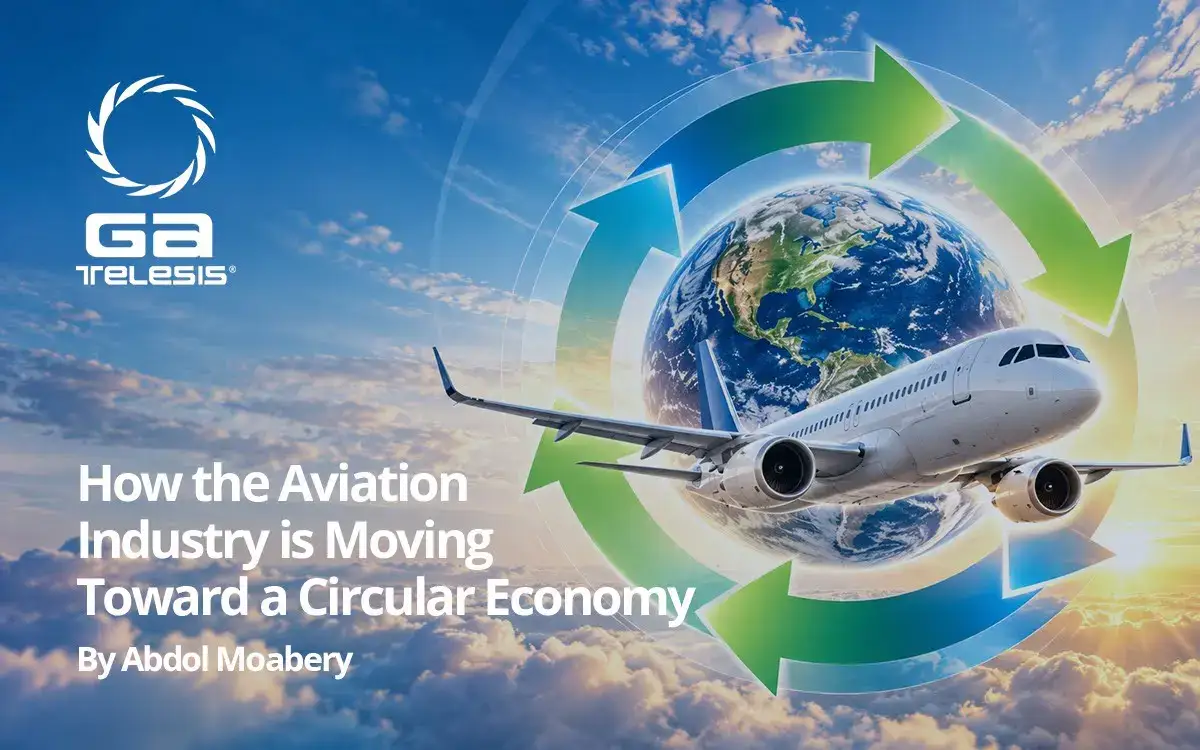
GA Telesis promotes sustainability in aviation with circular economy initiatives.
What a circular economy means in aviation
An aircraft reaching the end of its operational life does not mean the end of its value. A retired airframe contains serviceable components that can return to service and materials that can be recovered and recycled. This is the circular economy in aviation: keeping parts and materials in use for as long as possible and maximizing the value of an aircraft throughout and beyond its operational life.
The aviation aftermarket plays a central role in making that cycle possible. Aircraft are acquired at or near end of life and responsibly disassembled, serviceable components are inspected and returned to the market as used serviceable material (USM), repair and overhaul extend the life of additional components, and remaining materials are directed toward recycling. Each step keeps valuable resources within the aviation ecosystem while reducing waste and the need for new production.
As the industry works toward IATA’s goal of net-zero carbon emissions by 2050, circularity supports those broader sustainability efforts while also delivering clear business value. Extending component lifecycles, recovering materials, and increasing the use of USM can help operators manage costs and strengthen supply chain resilience. In aviation, sustainability and economics increasingly point in the same direction: getting more value and more useful life from the assets and materials already in the industry.
Step one: acquisition and the end-of-life decision
The flywheel or loop starts with a decision about a specific asset. An aircraft or engine reaches a point where continued operation no longer pays, whether because of its maintenance schedule, its fuel burn against newer types, or a fleet transition the operator has already committed to. At that point the owner has a choice. Park it, part it out, or sell it to someone who will. Then there is a scenario, when the scarcity of certain high demand aircraft and engine components has reached a point where traditional supply channels alone cannot satisfy market requirements. In some cases, the availability constraints and value of the underlying components make it economically compelling to acquire relatively new, serviceable aircraft specifically for disassembly. By strategically harvesting these assets, GA Telesis can rapidly introduce scarce, high value USM into the market, providing airlines and MROs with immediate access to critical components that may otherwise carry extended OEM lead times or simply be unavailable. This dynamic is fundamentally changing aircraft lifecycle economics and creating opportunities to disassemble aircraft at ages that historically would have been considered unusually young.
This is where an aftermarket partner enters. Acquiring an aircraft or engine for teardown is an appraisal exercise before it is a mechanical one. The value is in the parts inventory the asset carries, the demand for those part numbers, the remaining life on the high value rotables, and the documentation that comes with them. A retired widebody with strong demand for its engines is worth far more disassembled than parked. Getting that judgment right is what turns a grounded asset into recovered capital for its former owner, and it is the first place the circular economy creates value rather than just claiming it.
Step two: responsible disassembly and recycling
The loop’s physical work begins where an aircraft’s flying life ends. Responsible aircraft disassembly is a controlled, documented process, not a demolition. Serviceable components are removed for reuse first, hazardous fluids and materials are drained and handled to standard, and the remaining structure is separated so metals and other materials can be recycled rather than buried.
Standards are what separate this from scrapping. The Aircraft Fleet Recycling Association (AFRA) maintains the Best Management Practice, described as the only industry-developed standard for aircraft disassembly and materials recycling. Working to a recognized standard is what makes recovery repeatable and auditable, so a buyer downstream can trust how a part was removed and how the airframe was handled. Disassembly done this way recovers a large share of an aircraft by weight as reusable parts or recyclable material. The contrast with sending an airframe to landfill is stark, and it is the difference between aircraft recycling as a headline and a genuine practice.
The two outputs of this step are different in kind. High-value serviceable components come off first and flow into the reuse economy described below. The airframe that remains, mostly aluminium with other alloys and composites, flows into material recycling, where recovered metal re-enters manufacturing supply rather than being mined and smelted from ore. One output keeps parts flying. The other keeps material in circulation. Both displace something more carbon intensive.
Step three: USM keeps serviceable parts flying
The most valuable output of teardown is not scrap metal. It is the serviceable parts. Used serviceable material, or USM, is a component harvested from a retired aircraft or engine, inspected, and released back to service on another aircraft.
USM is where circularity and commercial value meet most directly. A reused part avoids the cost and the embodied carbon of manufacturing a new one, and it can shorten lead time when new material is slow or backordered. For an operator facing an aircraft on ground, a serviceable part that is available now can matter more than a new one that ships in weeks. That is the buyer’s real metric: availability and turn time, not the origin of the part.
The condition on all of this is traceability. A USM part is only as good as the documentation that proves it is airworthy. In practice that means an airworthiness release, an FAA 8130-3 or an EASA Form 1, attributed to those authorities, plus the back-to-birth or maintenance history the part number requires. Without complete paperwork a part has no value in this market, however sound it looks. This is why USM is a documentation business as much as a physical one, and why a credible supplier is judged on the records as much as the parts. GA Telesis harvests and distributes USM through its Flight Solutions Group, and keeps serviceable assets such as landing gear available for sale, lease, and exchange so an operator can source a ready asset instead of waiting on a full overhaul.
Step four: repair and overhaul extend part life
Not every harvested component is ready to fly again as-is, and not every part on an in-service aircraft needs replacing with new. Repair and overhaul sit inside the loop precisely here. A component that is worn but not scrap can be restored to a serviceable condition and returned, which extends its life for another cycle rather than ending it.
This is the step that keeps the loop from being a one-way harvest. An engine part, a landing gear assembly, or a composite structure that is overhauled to standard re-enters service with released paperwork, the same as a USM part. GA Telesis runs this work across engine, component, composite, landing gear, and wheels and braking systems through its MRO services. The reason for repair belongs in a circular-economy article and not only a capability page is simple. Every overhaul that returns a part to service is one new part that does not have to be manufactured, with the cost and carbon that would have carried.
Why circularity lowers cost and emissions at the same time
It would be easy to file all of this under sustainability and move on, but that undersells it. Circularity solves commercial problems and environmental ones with the same actions, which is what makes it durable rather than a program that gets cut in a hard quarter.
Start with cost. A reused or overhauled part is priced below a new equivalent, so every USM component and every overhaul lowers the maintenance bill on a fleet. Recovering value from retired assets improves the economics of a fleet transition, since the outgoing aircraft funds part of the incoming one. And a reuse-and-repair supply of parts adds resilience when new-part lead times stretch, which they periodically do across the industry. Availability is its own form of savings when the alternative is an aircraft on ground.
Now the emissions side, stated carefully. Manufacturing a new aviation part carries embodied carbon, the emissions locked into extracting the material, forming it, and machining it to spec. Reusing a serviceable part or overhauling an existing one avoids most of that, and recycling the airframe’s metal displaces primary production. None of this is the whole answer to aviation’s footprint. IATA frames the path to net-zero by 2050 as a mix of levers, with sustainable aviation fuel expected to deliver the largest single share, roughly 65 percent of the reduction, and the rest from new technology, improved operations and infrastructure, and offsetting. The aftermarket’s contribution is not fuel. It is that reuse and repair cut embodied carbon now, with today’s fleet, while the larger levers scale up.
What it means for buyers and operators
For the people making decisions, the loop changes two things. When you retire an asset, its end-of-life value is real and worth appraising properly, not an afterthought to be scrapped. And when you maintain a fleet, USM and overhaul are legitimate sources of airworthy parts that can beat new on cost and lead time, provided the traceability is airtight. The discipline to demand is the paperwork. Ask how a part was disassembled, to what standard, and what release documentation it carries. A partner who runs the whole loop can answer all three.
That alignment is why circularity is becoming standard rather than optional. GA Telesis is a working example of the full sequence, from acquiring and tearing down assets, to distributing USM, to repair and overhaul that extends part life, backed by ISO 14001 certification for environmental management and set out on its ESG and sustainability page. The point is not a pledge. It is a business that already runs on the loop.
Aviation circular-economy FAQs
How much of an aircraft can be recycled?
Disassembly to a recognized industry standard recovers a large share of an aircraft by weight as reusable parts and recyclable material rather than landfill. The exact share depends on the aircraft type and the process.
What is aircraft teardown, or disassembly?
It is the systematic, documented removal of serviceable parts from a retired aircraft, followed by handling of hazardous materials and recycling of the remaining structure. Done to standard, it recovers both value and materials.
What is used serviceable material (USM)?
USM is a serviceable part harvested from a retired aircraft or engine and returned to service on another with an FAA 8130-3 or EASA Form 1 airworthiness release. It lowers cost and embodied carbon versus new, provided its traceability and release documentation are complete.
What documentation does a returned part need?
An airworthiness release such as an FAA 8130-3 or an EASA Form 1, plus the maintenance history the part number requires. Without that paperwork a part is not airworthy, whatever its condition.
Is aircraft recycling actually sustainable?
When it follows best-practice disassembly and recycling rather than scrapping, it keeps parts and materials in use and out of landfill, which is the core of a circular economy. It is one lever among several, not the whole answer to aviation’s footprint.
Partner with GA Telesis
The circular economy in aviation is already turning, and the aftermarket is where it happens.
See circularity in practice through GA Telesis’ Flight Solutions Group and its ESG and sustainability approach, or talk to GA Telesis about the end-of-life value in your assets.