







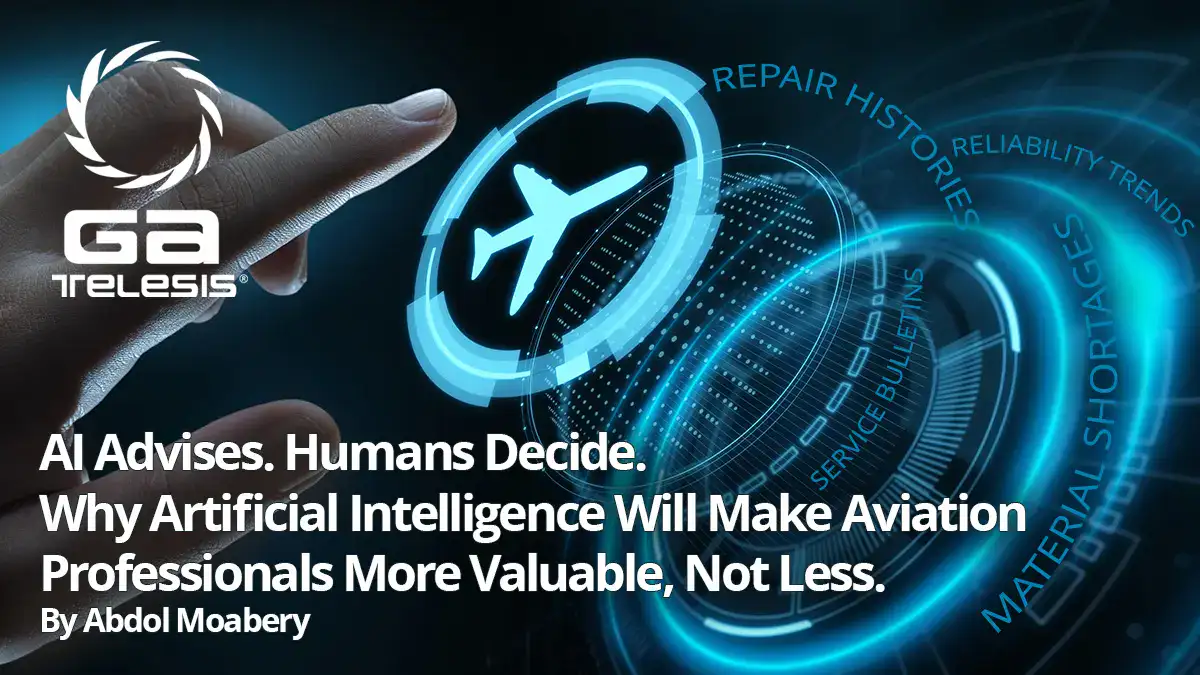
AI Advises. Humans Decide. Why Artificial Intelligence Will Make Aviation Professionals More Valuable, Not Less.
Author: GA Telesis
AI Advises. Humans Decide.
Why artificial intelligence will make aviation professionals more valuable, not less.
Every few weeks, another report predicts that artificial intelligence will replace millions of jobs. The headlines suggest that algorithms will soon outperform humans in everything from customer service to engineering, finance, and medicine. It is an interesting debate, but I believe commercial aviation, and aviation maintenance in particular, should be asking a different question.
The question is not whether AI can make better decisions. The question is whether aviation should allow it to.
Why Aviation Is Different
Unlike most industries, commercial aviation is not governed solely by economics or operational efficiency. It is governed by one of the most rigorous regulatory frameworks ever created, and it can differ from country to country. Every aircraft released to service, every engineering disposition, every maintenance release, every inspection, and every flight release ultimately rests with an MRO or an engineering organization where a qualified individual whose name, license, and professional reputation are attached to that decision.
That accountability is not accidental. It is the foundation upon which aviation safety has been built for decades.
What AI Does Brilliantly
As artificial intelligence continues to mature, there is little doubt that it will become remarkably proficient at analyzing technical data. It will identify trends hidden within millions of maintenance events, predict component failures with increasing accuracy, optimize inventory positioning, summarize technical publications, recommend repair alternatives, and accelerate engineering analysis far beyond what any individual could accomplish alone. In many cases, AI will become better than humans at analyzing information. But it doesn’t stop there. Civil aviation is not built solely on analysis. The two primary pillars propping up the global airline industry are safety and accountability.
What AI Cannot Do
For the foreseeable future, I find it difficult to imagine regulators delegating legal authority for airworthiness decisions to an algorithm, regardless of how sophisticated it becomes. Regulators certify organizations, processes, and licensed professionals. They do not certify artificial intelligence to independently exercise judgment over matters that directly affect safety. This distinction is often overlooked in discussions about AI.
Artificial intelligence cannot hold an Airframe and Powerplant certificate. It cannot become a licensed aircraft maintenance engineer. It cannot obtain Designated Engineering Representative authority. It cannot appear before the FAA, EASA, or the CAAC to explain why it reached a particular conclusion. Nor can it be held legally or professionally accountable when something goes wrong. HUMANS CAN!
That is why I believe artificial intelligence will become one of the most valuable tools our industry has ever adopted without fundamentally changing who is responsible for the final decision. Before you read on, say that last sentence once more in your head.
AI as a Force Multiplier in Aviation Maintenance
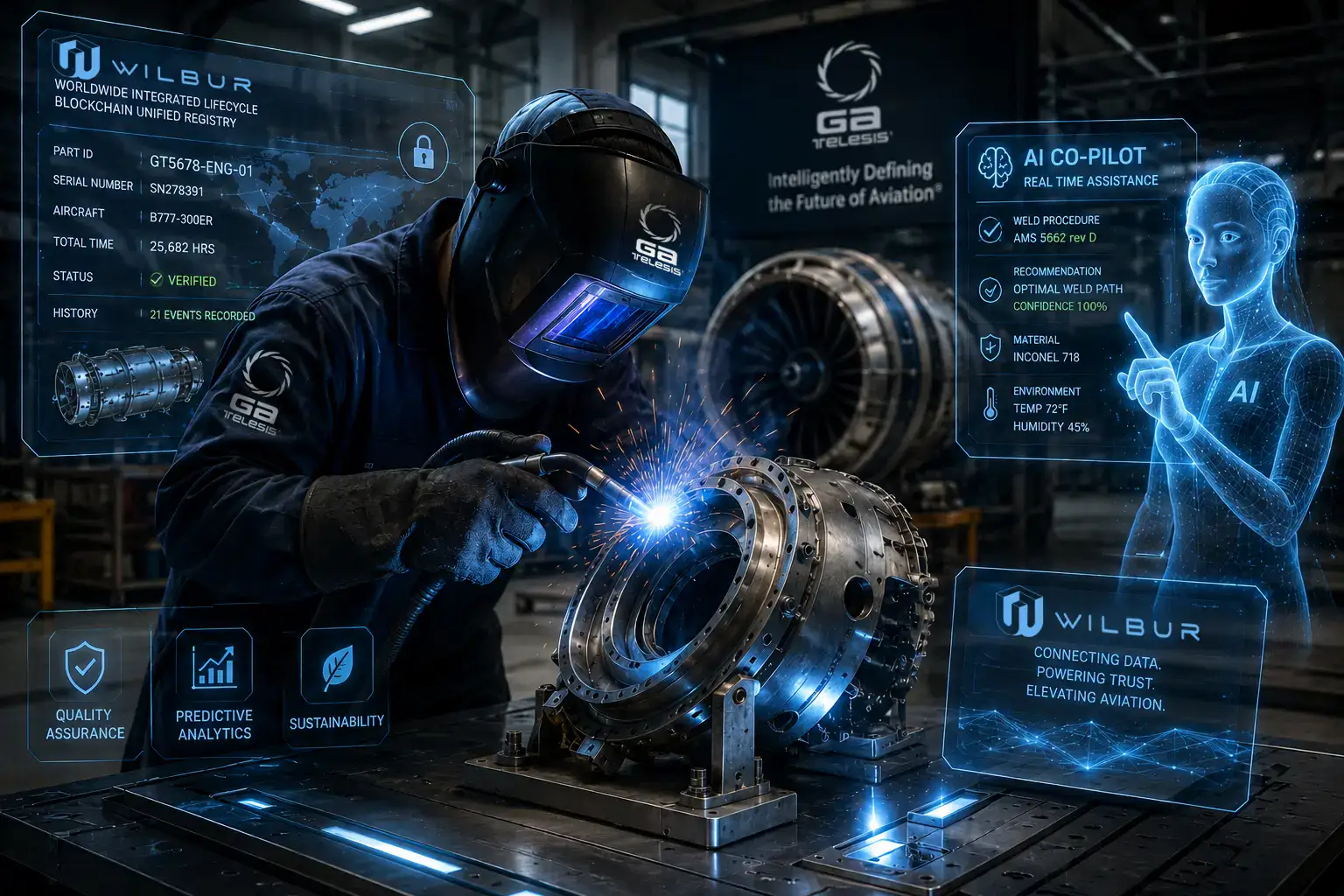
At GA Telesis, we witness this every day across our global maintenance, repair, and overhaul operations. Whether we are overhauling a landing gear, repairing an engine component, restoring a composite structure, supporting an airline through an AOG event, or evaluating the continued airworthiness of a critical aircraft component, our customers depend on highly trained professionals who apply experience, engineering knowledge, and sound judgment within an established regulatory framework. Artificial intelligence has the potential to make every one of those professionals better.
Imagine an engineer who begins the day with every relevant service bulletin, engineering order, repair history, and reliability trend already assembled before evaluating a repair disposition. Imagine a technician who spends minutes, not hours, locating technical data because AI has already organized the relevant maintenance records. Imagine maintenance planners identifying material shortages weeks earlier because predictive models continuously evaluate inventory demand across global fleets. Imagine reliability engineers recognizing emerging system failure patterns long before they become operational disruptions. None of those professionals become less important. They become significantly more capable.
Technology Has Always Augmented Expertise, Not Replaced It
Throughout aviation’s history, every meaningful technological advancement has followed the same pattern. Fly-by-wire systems did not eliminate pilots. Glass cockpits did not eliminate flight crews. Digital maintenance systems did not eliminate the need for technicians. Advanced diagnostic equipment did not eliminate inspectors. Technology removed repetitive work while increasing the importance of human expertise. Artificial intelligence represents the next evolution of that same journey.
The Workforce Challenge, and the Real Opportunity
This is particularly important as our industry confronts an aging workforce, increasing fleet complexity, persistent supply chain constraints, and a growing shortage of experienced aviation professionals. The challenge facing aviation is not an excess of talent. It is a shortage of highly qualified people. AI offers an opportunity to multiply the effectiveness of that workforce by eliminating administrative burden, accelerating research, improving planning, and providing richer decision support without removing human responsibility.
Leading the Next Generation of Aviation
The organizations that will lead the next generation of aviation will not necessarily be those with the most sophisticated artificial intelligence. They will be the organizations that integrate AI into every business process while preserving the judgment, accountability, and experience of the professionals entrusted to make critical decisions. Artificial intelligence should never be viewed as a substitute for aviation expertise; rather, it should be viewed as a force multiplier for it.
As our industry embraces the next generation of these digital tools, we should not measure success by the number of jobs artificial intelligence replaces. We should measure it by the number of better decisions it enables, the amount of unnecessary downtime it prevents, the operational resilience it creates, and the safety it helps preserve.
Aircraft are certified by regulators. Decisions are certified by people. Artificial intelligence should make those people smarter, faster, and better informed, but it should never replace the judgment for which they are ultimately accountable.
Simply put: AI advises. Humans decide.