








How GA Telesis is Using Data and AI to Improve MRO Efficiency
Author: GA Telesis
Takeaways
- GA Telesis is building a digital ecosystem through its Digital Innovation Group and its RADE analytics unit. When complete the system will integrate a Large Language Model (LLM), machine learning, blockchain tracking, and advanced analytics to create a data-driven approach to MRO operations and supply chain management.
- The WILBUR blockchain platform will be combined to eliminate the record-keeping inefficiencies by converting paper-based documentation into immutable digital records, with beta testing planned for Q3 2026.
- Effective AI for MRO efficiency requires enterprise-wide data integration, not isolated tool deployments. When done, GA Telesis plans to share its technology with the industry thus driving a full global industry digital transformation.
The aviation aftermarket is entering a new era of intelligence-driven operations. Airlines, OEMs, suppliers and MRO providers face mounting pressure to reduce turnaround times, control costs, and maintain fleet availability.
Artificial intelligence and data analytics in maintenance operations have moved from a niche experiment to a core operational requirement. At GA Telesis, we are a leading global aviation and aerospace services company operating across 54 locations in 30 countries, and are leading this transformation by investing in AI, machine learning, Web 3 blockchain, and advanced data platforms to reshape how MRO operations are planned, executed, and optimized.
In this article I will explain how GA Telesis is using AI to improve MRO efficiency and what that approach signals for the broader aviation maintenance industry.
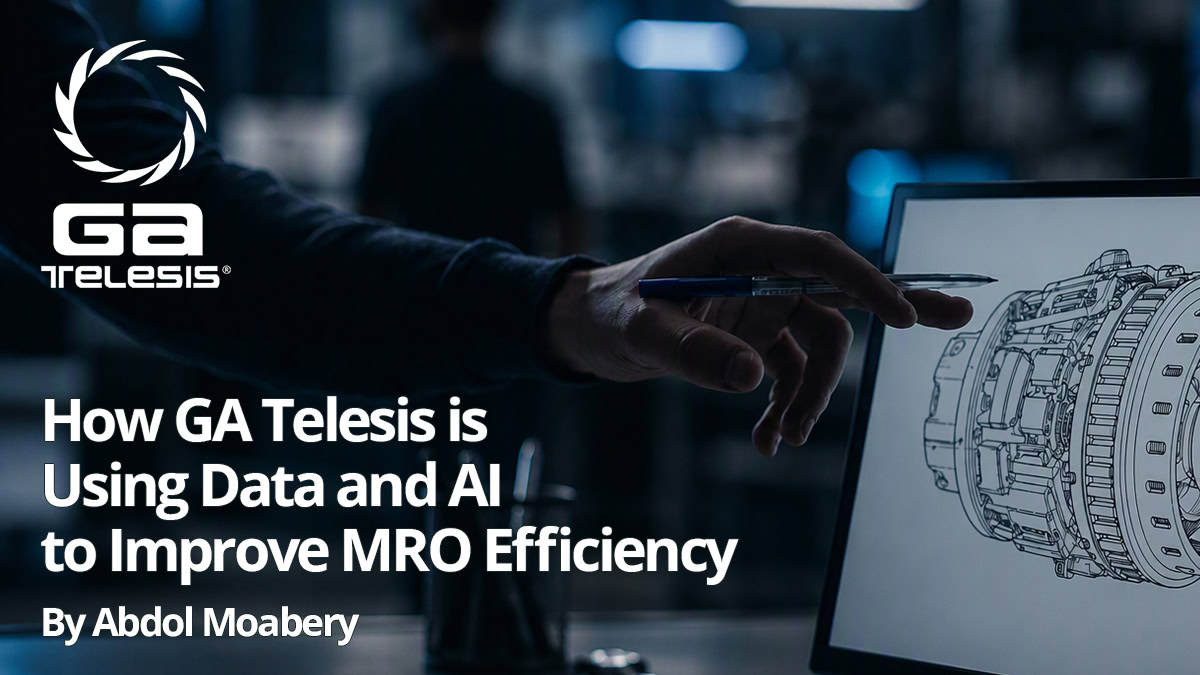
GA Telesis uses data and AI to enhance MRO efficiency in aircraft engine maintenance.
AI in aviation maintenance is transforming the relationship between data and decision-making in MRO environments. Traditional maintenance operations generate vast amounts of information, such as flight data, component performance records, work order histories, and inventory transactions. Much of this data has historically been siloed, underutilized, or trapped in paper-based systems.
The introduction of LLMs and machine learning into these workflows allows MRO providers and airlines to extract actionable insights from operational data. Pattern recognition algorithms can identify failure trends across fleets. Natural language processing can parse unstructured maintenance records. Predictive models can forecast parts demand and component degradation based on real-world operating conditions rather than generic manufacturer estimates.
Recognizing the potential of AI-driven MRO early on, we established the Digital Innovation Group (DIG) almost a decade ago to develop and commercialize advanced technologies for the aviation and aerospace aftermarket. The group mandate covers predictive maintenance, artificial intelligence, machine learning, big data analytics, and Web 3 blockchain-enabled provenance systems. This creates an integrated technology stack designed to modernize every layer of MRO operations.
Challenges Airlines Face in Aircraft Maintenance Efficiency
Before exploring our technology initiatives, it is important to understand the key challenges facing aircraft maintenance and why more advanced maintenance solutions are needed to address them.
Data Silo Challenges in Traditional Aircraft Maintenance
The aviation maintenance industry has relied on many of the same documentation systems and processes for decades and all of them are unique silos. Paper-based records, disconnected enterprise resource planning (ERP) systems, and manual verification procedures make it difficult to efficiently capture, store, and access maintenance information.
One of the biggest challenges is component traceability. Confirming an aircraft’s history and airworthiness requires reviewing installation and removal records, maintenance histories, regulatory certifications, and repair documentation.
These challenges increase turnaround times during heavy maintenance, delay parts verification, and make it harder to identify maintenance trends across fleets. As a result, airlines face higher costs and a greater risk of unexpected maintenance events and for MRO directors and fleet reliability managers, these data challenges translate directly into operational risk. Longer turnaround times during heavy checks, delayed parts verification during asset transactions, and a limited ability to perform fleet-wide trend analysis make it difficult to prevent costly unscheduled maintenance events.
Contact GA Telesis to discuss how to optimize your fleet maintenance strategy.
How GA Telesis Uses Data Analytics to Improve Maintenance Decisions
Data analytics have become a key part of the company’s operations, supporting decision-making across commercial, supply chain, and maintenance activities.
Real-Time Aircraft Data Improving Maintenance Decisions
In late 2025, GA Telesis launched the Revenue Analytics and Data Enablement (RADE) group to strengthen data use across the business. The team focuses on improving forecasting, pricing, automation, and decision-making by using operational data more effectively.
By bringing analytics into a single dedicated group, GA Telesis can apply consistent analytics across its Flight Solutions Group, MRO services, engine overhaul operations, and leasing business. This allows insights from one area of the business to support decisions in another.
The results have been significant. Proprietary analytics helped drive year-over-year growth in the Flight Solutions Group by more effectively matching inventory to customer demand.
WILBUR Will Revolutionize Aircraft Records Tracking
Our Digital Innovation Group and Ankara R&D Center, Türkiye launched in 2024. Perhaps our most ambitious digital strategy element is WILBUR, or Worldwide Integrated Lifecycle Blockchain Unified Registry. It is a patented blockchain-based platform designed to modernize aircraft parts traceability.
WILBUR converts traditional aviation documentation into secure digital tokens recorded on a globally distributed smart contract blockchain.

Each token captures lifecycle data, including trace history, installation and removal records, and airworthiness certifications. The platform’s proprietary hierarchical token architecture digitally links individual parts to assemblies, engines, and aircraft, creating an interconnected lifecycle registry that follows each asset throughout its operational life.
The concept originated in 2019 under our CEO, Abdol Moabery, with the first patent filed in 2021. We completed a proof of concept in mid-2025, populating WILBUR with component data from its Quantum ERP system. The beauty of the system is that it is ERP agnostic.
Our DIG president, Jason Reed, says that the proof of concept successfully created digital twins for hundreds of thousands of parts across GA Telesis facilities.
For MRO directors and supply chain leaders, WILBUR represents a shift from verifying parts through manual paper review to accessing instantly verifiable digital records.
Automation and Analytics in Aviation Maintenance Planning
We are applying AI and analytics beyond component-level prediction to broader maintenance planning and supply chain optimization. Our algorithms analyze usage patterns, customer demand signals, and inventory velocity to position parts near anticipated demand.
This approach, sometimes called predictive pooling, uses historical data and real-time analytics to anticipate when and where specific parts will be required. For airlines managing aircraft-on-ground situations, where every hour of downtime means lost revenue, having the right component at the right location can mean a fast return to service rather than an extended ground event.
We acknowledge that industry-wide adoption of predictive pooling is still in its early stages, as it requires cross-industry data-sharing agreements, a key requirement that many airlines and MROs have not yet fully established. However, our scale and integrated business model, which spans parts distribution, leasing, engine overhaul, and component MRO, positions us to build these predictive capabilities within our own ecosystem while working to extend them across the broader supply chain.
The Future of Data-Driven MRO Operations
Our investments in AI and data technology reflect our conviction that the aviation aftermarket is approaching a major structural transformation, one that will reward companies capable of converting operational data into predictive intelligence, supply chain agility, and verifiable asset integrity.
For airline maintenance leaders, MRO directors, and fleet reliability managers evaluating their own digital strategies, our approach offers several instructive principles that reinforce this broader shift.
First, AI-driven MRO efficiency gains require enterprise-wide data consolidation, not isolated tool deployments.
Second, these predictive capabilities are only as strong as the underlying data infrastructure that feeds them.
Third, the most transformative applications of digital MRO platforms will be those that address systemic industry challenges.
As WILBUR moves into beta testing, we continue to expand our analytics and AI capabilities, and this trajectory shows how data-driven strategies can reshape MRO operations at scale.
Learn more about GA Telesis MRO services today.
Frequently Asked Questions
How is GA Telesis using AI to improve MRO efficiency?
GA Telesis applies AI, machine learning, and data analytics across its MRO operations to turn siloed maintenance data into predictive intelligence. Pattern-recognition models spot fleet-wide failure trends, natural language processing parses unstructured maintenance records, and predictive models forecast parts demand and component degradation from real operating conditions rather than generic manufacturer estimates.
What is WILBUR?
WILBUR (Worldwide Integrated Lifecycle Blockchain Unified Registry) is GA Telesis’s patented blockchain platform for aircraft parts traceability. It converts paper documentation into secure digital tokens that capture each part’s trace history, installation and removal records, and airworthiness certifications, digitally linking parts to assemblies, engines, and aircraft across their operational life.
When will WILBUR be available?
WILBUR completed a proof of concept in mid-2025 using component data from GA Telesis’s Quantum ERP system, and beta testing is planned for Q3 2026.
What is predictive pooling in aviation maintenance?
Predictive pooling uses historical and real-time analytics to anticipate when and where specific parts will be needed, positioning inventory near expected demand. For airlines facing aircraft-on-ground situations, having the right component in the right place can turn an extended ground event into a fast return to service.
What is GA Telesis’s RADE group?
RADE (Revenue Analytics and Data Enablement), launched in late 2025, is GA Telesis’s dedicated analytics team. It sharpens forecasting, pricing, automation, and decision-making by applying consistent analytics across the Flight Solutions Group, MRO services, engine overhaul operations, and leasing business.
Why does effective AI in MRO require enterprise-wide data integration?
AI models are only as strong as the data feeding them. Isolated tools drawing on siloed, paper-based records can’t surface fleet-wide trends. Consolidating maintenance, inventory, and operational data across the enterprise is what lets predictive models deliver reliable insight, which is why GA Telesis built an integrated technology stack, not point solutions.